
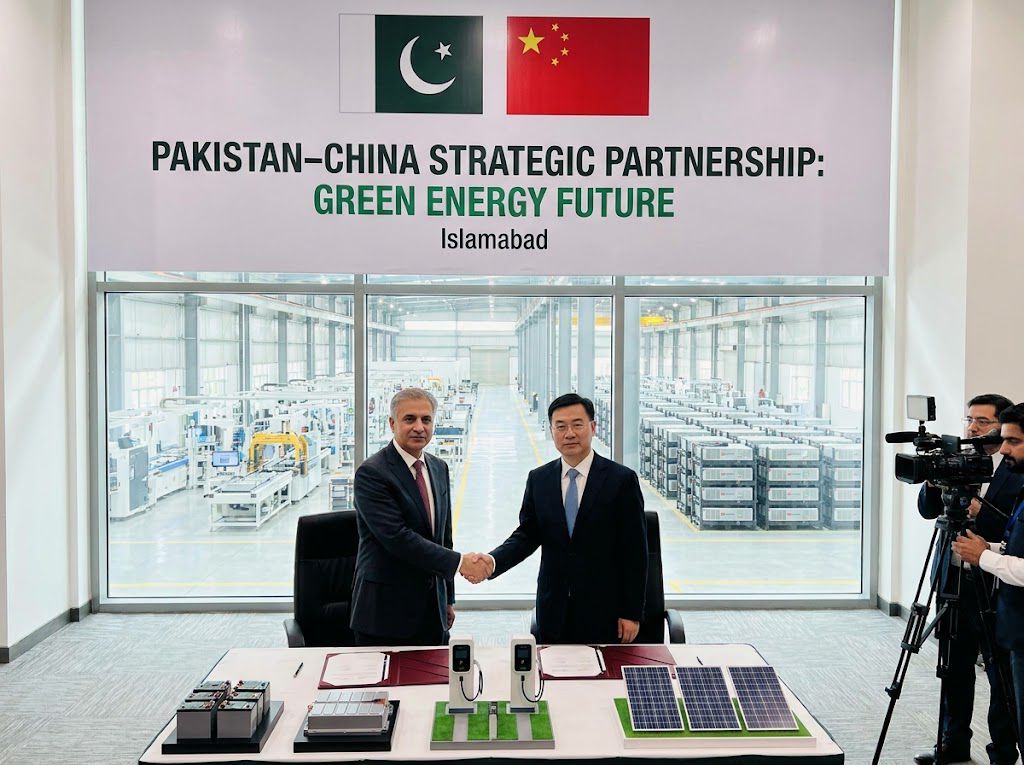
ISLAMABAD: Pakistan and China have signed a Memorandum of Understanding (MoU) to cooperate on advanced lithium-ion batteries, energy storage systems, EV charging infrastructure, and other clean energy technologies.
The agreement was signed between Saigols Group of Pakistan and Hebei Juhang Energy Technology Group of China. The partnership aims to strengthen collaboration in battery technology, clean energy solutions, and electric vehicle infrastructure.
Speaking at an event held to mark the MoU signing, Special Assistant to the Prime Minister on Industries and Production Haroon Akhtar Khan said the proposed lithium-ion battery assembly and manufacturing facility in Pakistan represents far more than a single investment. He said it signals the beginning of a new industrial ecosystem that combines Chinese technological expertise with Pakistan’s entrepreneurial potential and strategic geographic location.
Haroon Akhtar Khan described the agreement as more than a commercial partnership, calling it “a declaration of confidence in Pakistan’s industrial future and in the enduring strength of Pakistan-China cooperation.”
He said the relationship between Pakistan and China has continued to evolve in line with changing global realities and new economic opportunities. What began as a partnership built on trust, he said, has developed into one of the world’s most successful models of strategic cooperation. According to him, that relationship is now entering a new phase driven by innovation, advanced manufacturing, clean energy, technology transfer, and industrial collaboration.
Haroon Akhtar Khan added that China’s transformation into a global leader in innovation, electric vehicles, battery technology, renewable energy, artificial intelligence, and advanced manufacturing offers important lessons for developing economies. He said Pakistan is proud to deepen its partnership with China as both countries work together to shape the industries of the future.
He also emphasized that the global economy is undergoing a major shift, with technological innovation, intelligent manufacturing, and green industries emerging as key drivers of economic competitiveness.
Referring to the government’s reform agenda, Haroon Akhtar Khan said it includes the National Industrial Policy, the National Tariff Policy, and a broad Regulatory Reform Programme. These initiatives are designed to reduce the cost of doing business, simplify regulatory procedures, and create a transparent, predictable, and investor-friendly business environment.
“As I have often said, we are replacing red tape with red carpets for investors,” he said.
He further noted that Pakistan is witnessing one of the fastest expansions of solar energy adoption in the region, increasing the need for reliable energy storage systems. Local manufacturing of advanced lithium-ion batteries, he said, would help reduce dependence on imports, strengthen Pakistan’s clean energy supply chain, create high-value jobs, develop local engineering capabilities, and support related industries across the manufacturing sector.
Calling battery manufacturing one of the most strategic industries of the twenty-first century, Haroon Akhtar Khan said industrialization must be driven by innovation, technology, and sustainability to secure long-term national prosperity.
He reaffirmed the Government of Pakistan’s commitment to facilitating strategic investments and ensuring that Pakistan remains a reliable, competitive, and rewarding destination for international investors.
Haroon Akhtar Khan expressed confidence that the MoU would mark the start of a new chapter in Pakistan’s industrial transformation and pave the way for further investment, technology transfer, and long-term economic cooperation.