
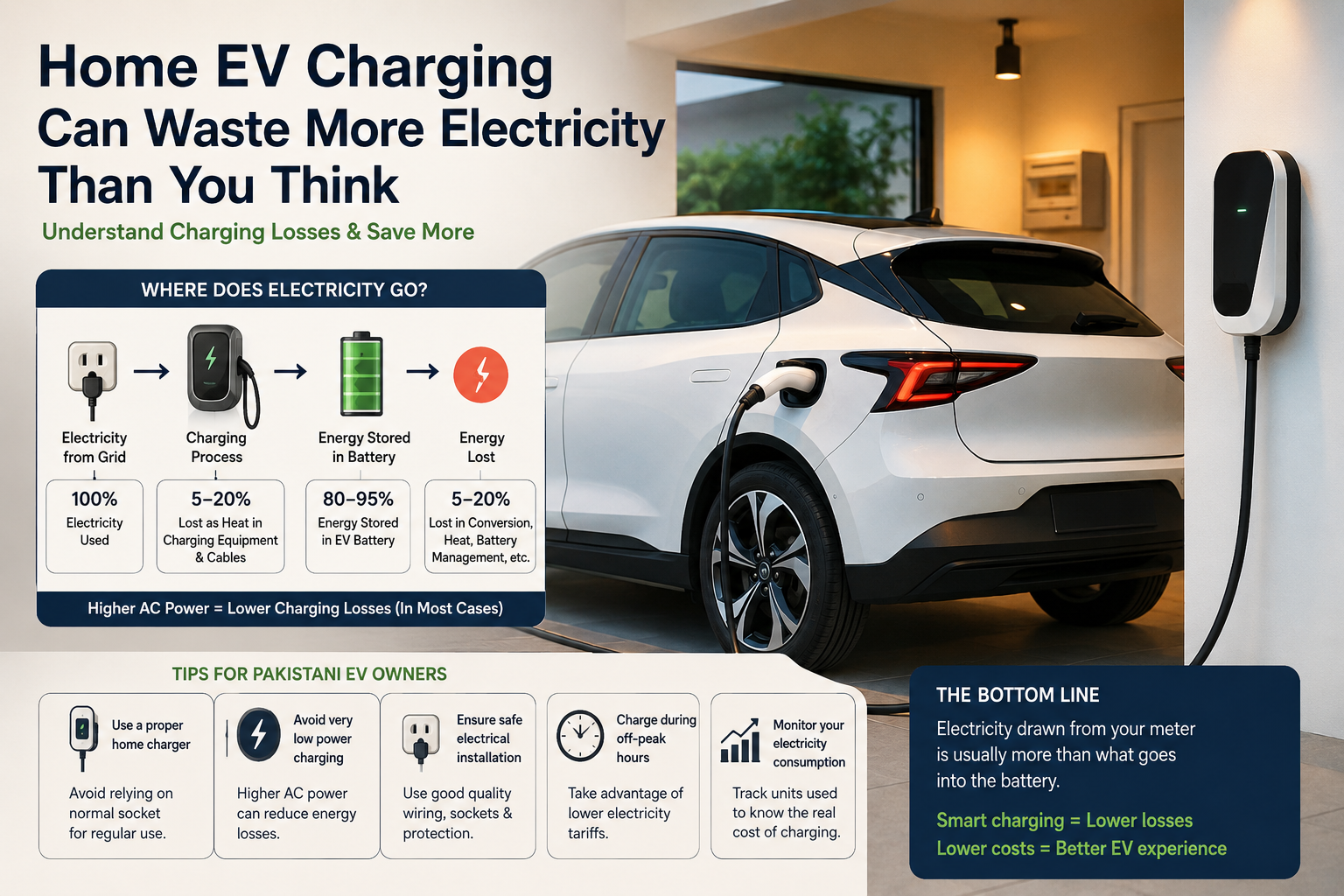
Charging an electric vehicle at home is one of the most convenient and often most affordable ways for Pakistani EV owners to keep their vehicle running. But the electricity recorded by your home meter is not exactly the same amount of energy that ends up stored inside the EV’s battery.
Some electricity is lost during charging. That means an EV owner may pay for more electricity than the amount ultimately stored in the battery.
This becomes particularly important in Pakistan, where many EV owners charge at home and may use a standard household socket, a portable charger or a dedicated wall charger. The charging setup, power level, wiring and the vehicle’s onboard charging system can all affect how efficiently electricity is transferred into the battery.
What Are EV Charging Losses?
Charging losses are the difference between the electricity drawn from the power supply and the energy that is actually stored in the EV’s battery.
For example, if your electricity meter records 30 kWh during a charging session but only 27 kWh is stored in the battery, around 3 kWh has been consumed by the charging process and other electrical systems.
These losses can come from several sources, including the EV’s onboard charger, electrical conversion, charging cables, connections and battery thermal-management systems.
In simple terms, your electricity bill measures what the car takes from your home, while the battery only receives the portion that remains after charging losses.
Why This Matters for EV Owners in Pakistan
Home charging is particularly important for Pakistan’s growing EV market. Many electric cars, bikes and scooters are charged overnight at homes rather than at public charging stations.
For an owner who charges occasionally, a few extra units of electricity may not seem significant. But for someone charging an EV every day, even a small percentage of charging loss can add up over hundreds of charging sessions.
This is especially worth considering when comparing the running cost of an EV with a petrol or diesel vehicle. The most accurate calculation should be based on the electricity consumed from the meter rather than simply the battery capacity.
Low-Power Charging Can Increase Energy Losses
Independent testing by Germany’s ADAC found that charging losses can vary considerably depending on the charging power and vehicle.
The testing compared five electric vehicles using different AC charging setups, including a 2.3 kW mobile charger, a 4.1 kW setup and higher-power 11 kW and 22 kW AC charging where supported.
The results showed a general trend: charging at very low AC power can result in higher charging losses than using a higher-power AC charging setup.
This does not mean that every EV should always be charged at maximum power. The ideal charging method depends on the vehicle, electrical installation, battery requirements and available charging equipment.
What Did the ADAC Test Find?
The following figures come from ADAC’s controlled charging tests. They are useful for understanding how charging efficiency can vary, although the tested vehicles are not representative of every EV available in Pakistan.
| EV | 2.3 kW | 4.1 kW | 11 kW | 22 kW |
|---|---|---|---|---|
| Mercedes-Benz CLA 350 with EQ Technology | 24.2% | 12.8% | 6.9% | Not supported |
| Renault 5 E-Tech | 13.7% | 8.0% | 5.1% | Not supported |
| Tesla Model Y | 12.7% | 9.4% | 6.1% | Not supported |
| Volvo EX30 | 14.2% | 9.1% | 7.0% | 6.7% |
| Volkswagen ID.7 | 15.3% | 10.6% | 6.9% | Not supported |
The charging sessions were conducted between 10% and 90% state of charge, with battery temperatures controlled within a specified range.
What Does This Mean for EVs Available in Pakistan?
The exact charging-loss percentage of an EV depends on its charging hardware and operating conditions, so the ADAC figures should not be directly applied to every EV sold in Pakistan.
However, the basic principle is highly relevant to Pakistani EV owners.
Whether you drive an electric car such as a BYD Atto 3, BYD Seal, MG4 EV or another imported EV, or use a locally available electric bike or scooter, the electricity consumed from the wall will generally be higher than the energy ultimately stored in the battery.
For smaller EVs, including electric bikes and scooters, charging losses can also matter when calculating the true cost per kilometre. The same principle applies: the most useful figure for calculating running costs is the electricity drawn from the socket or meter, not simply the nominal battery capacity.
Because charging systems differ between models, Pakistani EV owners should check the manufacturer’s recommended charger and electrical requirements rather than assuming that a particular charging-loss percentage applies to their vehicle.
Charging From a Normal Household Socket
Many EV owners in Pakistan may be tempted to use a normal household socket because it is convenient and does not require installing a dedicated wall charger.
For compatible vehicles and chargers, this can work, but it is not necessarily the most efficient or suitable solution for frequent EV charging.
Low-power charging can take considerably longer. During a long charging session, the vehicle’s electronics and other charging systems continue consuming electricity even though the battery is being charged relatively slowly.
For regular daily charging, a properly installed dedicated charger can therefore be a better solution, provided the vehicle supports it and the home’s electrical system can safely handle the required load.
Why a Dedicated EV Charger Can Make Sense
A dedicated AC charger can provide a more controlled charging setup than repeatedly relying on a basic household outlet.
For Pakistani EV owners, the advantages can include:
- More predictable charging times
- A dedicated electrical connection
- Better suitability for regular overnight charging
- Reduced dependence on extension cables and temporary connections
- Potentially lower charging losses when the vehicle operates efficiently at the higher charging power
However, installing a higher-power charger does not automatically guarantee lower electricity consumption. The charger’s efficiency, the EV’s onboard charger, battery temperature and charging conditions all matter.
Do Not Use Cheap Extension Cables for EV Charging
One of the most important considerations for home charging in Pakistan is the quality of the electrical installation.
EV charging can draw substantial current for several hours. A poor-quality extension cable, loose socket, undersized wiring or overloaded circuit can create heat and increase safety risks.
If you regularly charge an EV at home, it is better to have the charging point inspected and installed by a qualified electrician using appropriately rated wiring, protection devices and sockets.
This is particularly important for higher-power AC charging.
Charging Losses Are Not the Same as Battery Losses
It is also important to distinguish charging losses from battery degradation.
Charging losses happen during the process of transferring electricity from the electrical supply into the battery. Battery degradation, on the other hand, refers to the gradual reduction in battery capacity and performance over time.
An EV can have charging losses even when its battery is relatively new. Similarly, an older battery can have reduced capacity without necessarily having dramatically higher charging losses.
How Pakistani EV Owners Can Reduce Charging Costs
1. Use the Recommended Charger
Use the charging equipment recommended or approved for your EV. Avoid relying on unsuitable adapters or low-quality charging equipment simply because they are cheaper.
2. Avoid Unnecessary Very-Low-Power Charging
If your EV supports a suitable higher-power AC charger and your home’s electrical system is designed for it, charging at an appropriate higher power may improve charging efficiency compared with very low-power charging.
3. Keep the Charging Installation in Good Condition
Loose connections, damaged cables and poor-quality sockets should not be ignored. A properly maintained electrical connection is important for both safety and reliable charging.
4. Charge During Suitable Electricity Tariff Hours
Pakistan’s electricity tariffs can vary depending on the connection and tariff structure. EV owners should check their own electricity tariff and determine whether scheduled or off-peak charging can reduce the cost of charging.
Saving money through a lower electricity tariff can sometimes have a bigger impact on your total charging cost than small differences in charging efficiency.
5. Monitor Electricity Consumption
If you want to know the real cost of operating your EV, monitor how many units of electricity are being consumed during charging.
For example, if your EV has a 40 kWh battery, do not assume that charging it from empty to full will always consume exactly 40 kWh from the electricity supply. The actual amount drawn from the meter can be higher because of charging losses.
How to Calculate the Real Cost of Charging an EV
A simple way to estimate your actual charging cost is:
Charging cost = Electricity consumed from the meter × Your electricity rate
For example, if a charging session consumes 35 kWh from the electricity supply and your effective electricity cost is Rs. 50 per kWh:
35 × Rs. 50 = Rs. 1,750
The important point is that the 35 kWh figure should represent electricity taken from the supply rather than simply the battery’s rated capacity.
Your actual electricity rate may vary depending on your tariff, taxes, adjustments and other charges on your electricity bill, so this example is only for illustration.
Does Faster Charging Always Mean Lower Losses?
No. The ADAC test demonstrates that higher AC charging power can reduce charging losses in certain vehicles, particularly compared with very low-power charging, but it should not be interpreted as a universal rule that faster charging is always more efficient.
Different EVs use different onboard chargers and battery-management systems. Charging efficiency can also change depending on battery temperature, state of charge and the vehicle’s electrical systems.
For Pakistani EV owners, the best approach is to follow the vehicle manufacturer’s charging recommendations and use properly rated charging equipment.
The Bottom Line for Pakistani EV Owners
Home charging remains one of the biggest advantages of owning an EV in Pakistan, but the electricity shown on your meter will normally be higher than the energy stored in the battery.
Independent testing shows that charging losses can become particularly noticeable when EVs are charged at very low AC power. A suitable dedicated charger, good-quality electrical installation and sensible charging habits can help reduce unnecessary losses while making home charging safer and more convenient.
When comparing the running cost of EVs available in Pakistan, don’t calculate your electricity expense using battery capacity alone. Consider the electricity actually consumed during charging.
That gives you a much more realistic picture of what it costs to drive an EV on Pakistani roads.
Planning to buy an EV in Pakistan? Compare battery capacity, claimed range, charging time, running costs and other specifications before making your decision.